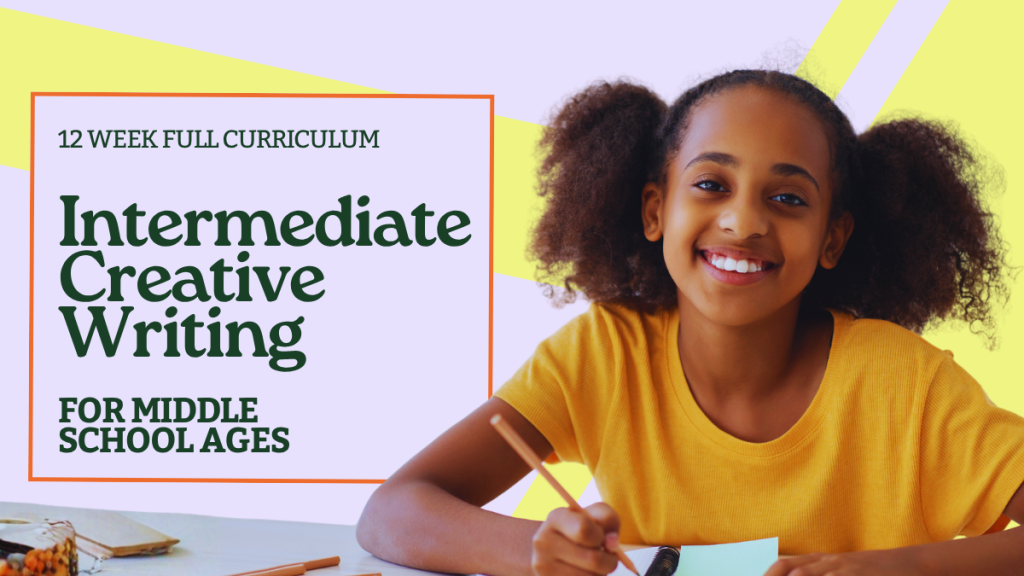
Full semester Intermediate Creative Writing class for middle school ages.
Intermediate Middle School Creative Writing is a self-paced course for middle school writers who already know the basics and are ready to go deeper. If your student understands what a story is and wants to learn how to make one that actually lands — with real tension, layered characters, meaningful subtext, and a voice that’s unmistakably theirs — this is the next step.
Over 12 weeks, students work through pre-recorded video lessons on the techniques that take storytelling beyond the surface: scene structure, internal and external conflict, subtext-loaded dialogue, setting as mood, character arcs, narrative voice, story openings, and pacing. Each week builds on the last, giving students hands-on experience with tools that make fiction feel alive.
Every week includes a video lesson, a creative activity, a writing prompt, and personalized written or audio feedback from a real instructor. The feedback is thoughtful and specific — designed to help each student strengthen their instincts, try riskier ideas, and develop their own creative voice.
Because the course is self-paced, students can move through the material on their own schedule without losing the structure and support of a real course. Assignments are flexible enough to work across any genre — fantasy, mystery, sci-fi, adventure, horror, realistic fiction, or anything in between.
By the end of the 12 weeks, students will have a collection of original work and a polished final story — along with stronger storytelling instincts and a much clearer sense of how to communicate emotion and meaning through fiction.
Week 1 — Scene Purpose and Conflict
Students learn how strong scenes serve the story — advancing plot, deepening theme, or revealing character — and practice writing their own conflict-driven scene.
Week 2 — Internal vs. External Conflict
The difference between emotional and physical challenges — and how to craft scenes where a character wrestles with both kinds at once.
Week 3 — Dialogue That Builds Character
How dialogue reveals personality and relationships. Students write a conversation that shows admiration and hidden tension at the same time.
Week 4 — Subtext in Dialogue
Characters who say one thing and mean another. Students practice writing conversations where the real meaning lives underneath — and learn why that’s more powerful than spelling it out.
Week 5 — Setting That Feels Alive
How to turn setting into a storytelling tool — writing scenes where the environment actively supports mood and meaning rather than just existing in the background.
Week 6 — Mood Through Setting
Students shift how a place feels based on tone and emotion — practicing how to reflect or contrast a character’s inner state with the world around them.
Week 7 — Static vs. Dynamic Characters
What it means for a character to grow — or not — and how to plan changes that feel real and earned rather than sudden or forced.
Week 8 — Showing Character Growth
How to show a character’s transformation through action and behavior over time, rather than telling the reader it happened.
Week 9 — Using Voice
Tone, personality, and point of view as storytelling tools. Students experiment with narrative voice and discover how much it shapes the way a story feels.
Week 10 — Story Openings
What makes a first line work. Students analyze strong openings and write their own — learning to hook readers with mood, conflict, or an irresistible question.
Week 11 — Pacing Techniques
How to speed up or slow down a scene using tension, sentence structure, and timing — so the story feels exactly how you want it to feel.
Week 12 — Final Story Project
Students expand a past piece into a polished short story, applying multiple techniques from across the course. A chance to see how far they’ve come.
CCSS.ELA-Literacy.W.6–8.3 — Narrative Writing
Students write original stories and scenes each week using increasingly sophisticated narrative techniques — including scene structure, internal and external conflict, subtext-driven dialogue, character arcs, and pacing — building toward a polished final story.
CCSS.ELA-Literacy.W.6–8.4 — Production and Distribution of Writing
Students produce clear, coherent writing appropriate to task, purpose, and audience — experimenting with tone, voice, setting, and story openings across a range of original pieces throughout the 12 weeks.
CCSS.ELA-Literacy.W.6–8.5 — Strengthening Writing Through Revision
Students expand and polish a past piece into a full final story in Week Twelve, applying multiple techniques learned across the course — with ongoing personalized instructor feedback supporting revision and growth throughout.
CCSS.ELA-Literacy.W.6–8.10 — Range of Writing
Students write consistently across 12 weeks, practicing a variety of scene types, techniques, and emotional registers — building range, stamina, and creative confidence over an extended time frame.
CCSS.ELA-Literacy.L.6–8.3 — Knowledge of Language
Students make deliberate choices about language, voice, and style — including dedicated work on narrative voice, tone, and how setting and word-level decisions shape a reader's emotional experience.
CCSS.ELA-Literacy.L.6–8.5 — Figurative Language and Nuance
Students explore subtext, mood, and the layered meanings beneath dialogue and setting — developing the ability to use language with nuance and emotional intention rather than stating meaning directly.
Create a parent account so we can save your child, enrollment, reminders, and checkout details.
You’ll come back to this class after creating your account.
Continue to enrollment when you’re ready.