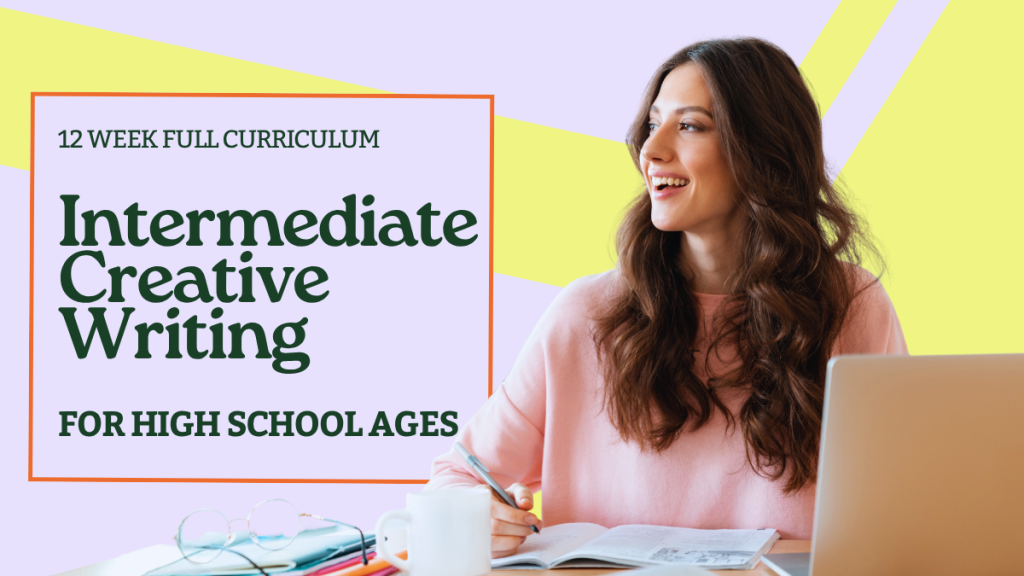
Full semester Intermediate Creative Writing for high school ages.
This is a craft-focused, semester-long course for high school writers who have some experience on the page and are ready to go deeper. If your teen knows the basics and wants to write with more intention — more layered characters, more control over pacing, more confidence in their own voice — this is the next step.
Over 12 weeks, students work through pre-recorded video lessons on the techniques that make stories feel alive: foreshadowing, irony, morally gray characters, POV experimentation, juxtaposition, suspense, dialogue, emotional subtext, flash fiction, and revision. Each week builds on the last, and by the end, students have a real toolkit — not just a list of terms, but hands-on experience using each one.
Every week includes a video lesson, a creative activity, a writing prompt, and personalized written or audio feedback from the instructor. The feedback is specific and individualized — focused on helping each student sharpen their instincts, take smarter risks, and develop their own voice.
Because it’s self-paced, students can move through the material on their own schedule without losing the structure and support of a real course. Assignments are flexible enough to work across any genre — fantasy, horror, romance, sci-fi, literary fiction, fanfiction, or anything else your teen loves to write.
By the end of the 12 weeks, students will have a portfolio of original work, a polished final story, and a much clearer sense of how to make their writing do exactly what they want it to do.
Week 1 — Literary Devices: Foreshadowing, Irony, and Motif
Students learn to spot and use foundational literary tools to add depth and unity to their stories — and start writing with more intentional technique.
Week 2 — Moral Gray Areas
Writers explore how flawed, complex characters create more compelling stories, then write a scene where the “right” choice isn’t obvious.
Week 3 — POV Shifts and Experiments
Beyond the basics of point of view — unreliable narrators, second person, shifted perspectives — and how each one changes what a reader understands and feels.
Week 4 — The Art of Juxtaposition
Students use contrast — humor in sadness, chaos in calm — to heighten emotional impact and create stories that hold more than one thing at once.
Week 5 — Tightening Pacing and Building Suspense
Sentence-level tools for controlling how fast or tense a scene feels. Writers practice shortening, rearranging, and breaking up text to build tension that pays off.
Week 6 — Writing Relationships
From friendship to rivalry, students explore how character relationships shape the emotional heart of a story — then write a scene where a relationship shifts.
Week 7 — Dialogue Without Tags
No “he said / she said” — writers use action beats, rhythm, and character personality to carry the conversation instead.
Week 8 — Rhythm and Flow in Editing
Students revisit past work with fresh eyes, focusing on sentence variety, repetition, and rhythm to improve readability and emotional clarity.
Week 9 — Exploring Form: Flash, Vignette, Snapshot
Ultra-short storytelling — capturing something powerful in under 250 words. Students write both a flash fiction piece and a vignette.
Week 10 — Writing the Silent Moment
Quiet scenes where mood, gesture, and subtext do the heavy lifting. Students write a moment that says a lot without saying much.
Week 11 — Final Story Draft
Writers plan and execute a full narrative of 900–1,200 words, pulling together theme, structure, and voice into one polished piece.
Week 12 — Self-Assessment and Reflection
Students look back at where they started, identify the techniques that clicked, and set their sights on what they want to write next.
CCSS.ELA-Literacy.W.9–12.3 — Narrative Writing
Students write original stories and scenes each week using narrative techniques including dialogue, pacing, POV shifts, unreliable narrators, and emotional subtext — developing characters, relationships, and event sequences with increasing complexity and control.
CCSS.ELA-Literacy.W.9–12.4 — Production and Distribution of Writing
Students produce clear, coherent writing in which development, organization, and style are matched to task, purpose, and audience — including flash fiction, vignettes, and longer narrative pieces.
CCSS.ELA-Literacy.W.9–12.5 — Strengthening Writing Through Revision
A dedicated editing and revision week, combined with ongoing personalized instructor feedback throughout the course, develops students' ability to revise with attention to rhythm, flow, clarity, and emotional impact.
CCSS.ELA-Literacy.W.9–12.10 — Range of Writing
Students write consistently across 12 weeks in a variety of forms — including flash fiction, vignettes, scene work, and full narrative drafts — building range and endurance as writers over an extended time frame.
CCSS.ELA-Literacy.L.9–12.3 — Knowledge of Language
Students make deliberate choices about language, sentence variety, and style — including a dedicated week on rhythm and flow in editing — developing stronger control over how language shapes meaning and reader experience.
CCSS.ELA-Literacy.L.9–12.5 — Figurative Language and Nuance
Students explore foreshadowing, irony, motif, juxtaposition, and emotional subtext as intentional craft tools, learning to use figurative language and nuance to deepen the impact of their stories.
Create a parent account so we can save your child, enrollment, reminders, and checkout details.
You’ll come back to this class after creating your account.
Continue to enrollment when you’re ready.