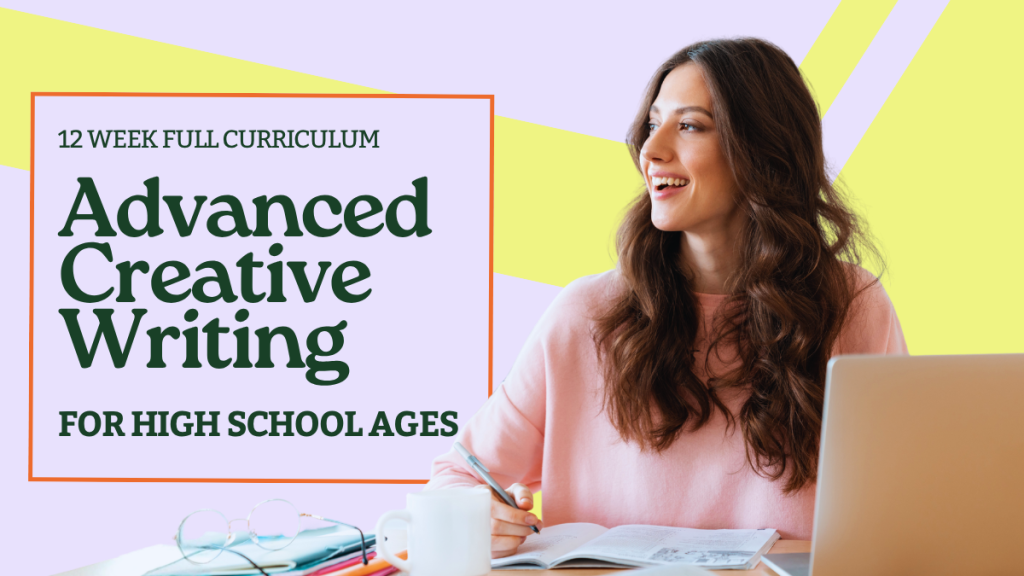
A full semester self-paced course for Advanced High School age learners.
This is a craft-focused, semester-long course for high school writers who are ready to move beyond the basics. If your teen already enjoys writing and wants to go deeper — into voice, structure, form, and the kind of revision that actually makes stories better — this is the class.
Over 12 weeks, students work through pre-recorded video lessons on advanced literary techniques: revision as reinvention, symbolism, experimental storytelling structures, emotional intimacy, metafiction, sentence-level editing, and more. They’ll experiment with unconventional forms — transcripts, lists, letters, fragmented narratives, stage directions — and learn how structure itself can shape the emotional impact of a story.
Every week includes a video lesson, a creative activity, a writing prompt, and personalized written or audio feedback from the instructor. The feedback is real and individualized — not generic encouragement, but specific guidance designed to help each student strengthen their craft and develop their own voice.
Because it’s self-paced, students can move through the material on their own schedule. The lessons are designed to feel conversational and creatively energizing, not dry or academic. Students are encouraged to take risks, try weird ideas, and figure out what kind of stories they actually want to tell.
By the end of the 12 weeks, students will have a portfolio of original work and a polished final piece — plus a clearer sense of themselves as writers.
This course works well for teens who write in any genre: fantasy, horror, sci-fi, literary fiction, romance, fanfiction, poetry, or anything in between. Assignments are flexible enough to adapt to each student’s own projects and interests.
Week 1 — Writing Identity and Intent
Students explore their own voice, favorite genres, and creative habits to build a clear sense of themselves as writers.
Week 2 — Reinventing Your Own Work
Writers revisit an older piece and rebuild it from scratch — new tone, new angle, new life.
Week 3 — Crafting Standalone Scenes
Focus on writing scenes that feel complete on their own, with tension and emotional movement that don’t rely on a larger story.
Week 4 — Breaking Form
Students experiment with nontraditional formats like lists, transcripts, second person, and stage directions — taking risks with structure while keeping their voice intact.
Week 5 — The Art of Juxtaposition
Writers explore contrast — pairing grief with humor, chaos with quiet — to create layered, emotionally resonant work.
Week 6 — Metafiction and Story Awareness
Students play with narrators who break the fourth wall, acknowledge their own story, or actively shape the plot.
Week 7 — Dialogue Without Dialogue Tags
Conversations that flow without “he said / she said” — using character voice, rhythm, and subtext instead.
Week 8 — Writing the Silent Moment
Quiet, emotional beats where gesture and imagery say more than dialogue. Students practice subtlety, pacing, and restraint.
Week 9 — Precision and Power: The Final Line Edit
Micro-editing week — sharpening prose at the sentence level for clarity, rhythm, and impact.
Week 10 — Final Project Planning
Students choose their form, tone, theme, and direction for the final piece and build a creative blueprint.
Week 11 — Final Drafting Time
No lesson this week — just dedicated time to draft, revise, and complete the final project.
Week 12 — Reflection and Release
Writers look back at where they started and forward to what they want to write next.
While the Beginner and Intermediate levels of this course are not required to enroll, they are highly recommended.
CCSS.ELA-Literacy.W.9–12.3 — Narrative Writing
Students write original stories and scenes each week using advanced narrative techniques — including dialogue, pacing, description, nonlinear structure, and multiple points of view — to develop experiences, events, and characters with depth and intention.
CCSS.ELA-Literacy.W.9–12.4 — Production and Distribution of Writing
Students produce clear, coherent writing in which development, organization, and style are intentionally matched to task, purpose, and audience — including experimental and unconventional forms.
CCSS.ELA-Literacy.W.9–12.5 — Strengthening Writing Through Revision
A dedicated revision week and ongoing instructor feedback throughout the course develop students' ability to plan, revise, rewrite, and try new approaches — with focus on what matters most for a specific creative purpose.
CCSS.ELA-Literacy.W.9–12.10 — Range of Writing
Students write consistently across 12 weeks, practicing a variety of genres, styles, and forms — building endurance and flexibility as writers over an extended time frame.
CCSS.ELA-Literacy.L.9–12.3 — Knowledge of Language
Students apply understanding of style, voice, and language choice as they work with sentence-level editing, dialogue, juxtaposition, and precision — making deliberate decisions about how language shapes meaning and emotional impact.
CCSS.ELA-Literacy.L.9–12.5 — Figurative Language and Nuance
Students explore symbolism, metafiction, juxtaposition, and emotional subtext — developing the ability to use figurative language and nuance as intentional craft tools, not afterthoughts.
Create a parent account so we can save your child, enrollment, reminders, and checkout details.
You’ll come back to this class after creating your account.
Continue to enrollment when you’re ready.