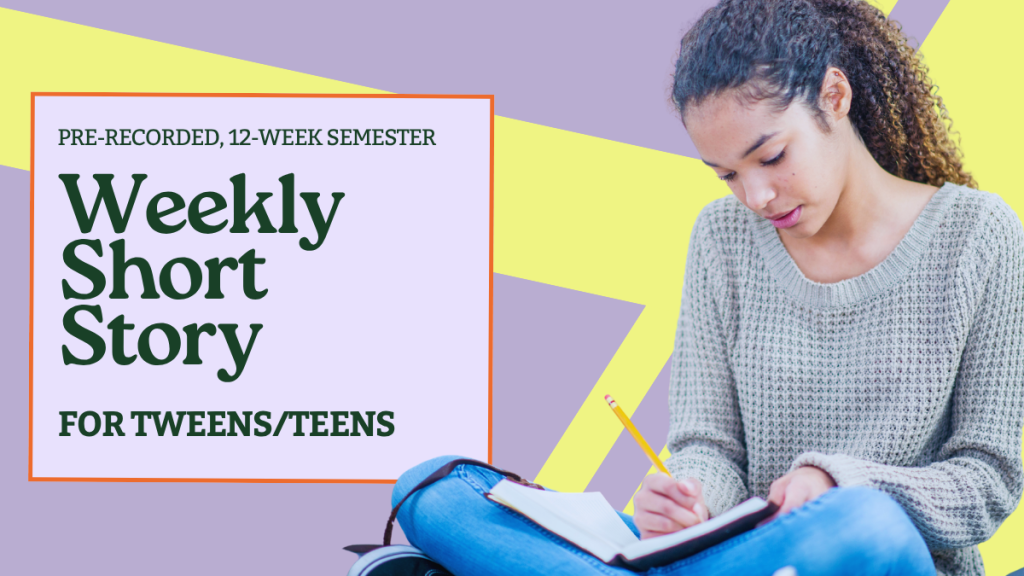
Explore creative writing with a new element, style, genre, or approach each week.
In this 12-week self-paced course, teen writers tackle a brand-new creative writing challenge each week — experimenting with different genres, techniques, and kinds of stories instead of spending the whole session stuck on one idea that may or may not be working for them.
One week we might work on creating a character with a problem they absolutely cannot ignore. Another week might focus on dialogue, tension, setting, plot twists, unreliable narrators, spooky stories, sci-fi problems, emotional stakes, or stories where one tiny choice makes everything go sideways.
Each week feels new on purpose. But the course is not just twelve random prompts.
Underneath all that variety, students are building a real storytelling skillset. Week by week, they’ll practice the pieces that make stories work: character, conflict, structure, voice, pacing, description, tension, theme, and revision. Every lesson gives students something specific to try right away, while also helping them become stronger, more confident storytellers over time.
This course is a great fit for teens who already love writing, teens who have stories in their heads but struggle to get them onto the page, and teens who need writing to feel a little less like an assignment and a little more like something they actually get to make.
Each lesson includes a pre-recorded mini-lesson (about 15–20 minutes) taught by a published author on the WordPlay team, with clear examples and direct guidance on one specific storytelling skill. After the lesson, students work through a writing prompt designed to help them immediately apply what they’ve learned — writing their own short story or scene for the week.
Students submit their work and receive brief, personalized written feedback from the teacher: what’s working, what to try next, and specific encouragement tied to that week’s focus.
Students are never required to polish their stories before submitting — the goal of this course is not to produce flawless pieces, but to try something new and unexpected each week.
At the end of the 12-week session, students may choose one story from their collection to send in for full editorial feedback.
This is more than a quick encouraging note. Students will receive thoughtful, specific feedback on what’s working, where the story could be stronger, and what they might revise next — similar to the kind of editorial notes a professional author might receive on a draft. Students don’t have to take this option, but for writers who are ready to take one piece a little further, it’s a chance to experience the revision-and-feedback process in a real, writer-focused way.
This course keeps writing from getting stale. Every week gives students something new to play with, so they can experiment, take creative risks, and discover what kind of stories they actually like writing. At the same time, the lessons connect — so students aren’t just producing more pages, they’re learning how stories are built. By the end of the twelve weeks, students will have a collection of new drafts, a stronger understanding of storytelling, and a clearer sense that writing is not about waiting for one perfect idea.
CCSS.ELA-Literacy.W.6–12.3 — Narrative Writing
Students write original stories and scenes each week, developing real or imagined experiences using effective technique, well-chosen details, and structured event sequences — including dialogue, pacing, description, and point of view.
CCSS.ELA-Literacy.W.6–12.4 — Production and Distribution of Writing
Students produce clear, coherent writing appropriate to task, purpose, and audience, with development and style that grows over the course of the 12 weeks.
CCSS.ELA-Literacy.W.6–12.5 — Strengthening Writing Through Revision
Students develop writing through a cycle of drafting and responding to instructor feedback, with focus on strengthening clarity, development, and craft.
CCSS.ELA-Literacy.W.6–12.10 — Range of Writing
Students write consistently across the course — one piece per week — practicing a variety of styles, genres, and approaches over an extended time frame.
CCSS.ELA-Literacy.L.6–12.3 — Knowledge of Language
Students apply their understanding of language conventions and style as they experiment with different genres, voices, and narrative techniques each week.
Create a parent account so we can save your child, enrollment, reminders, and checkout details.
You’ll come back to this class after creating your account.
Continue to enrollment when you’re ready.