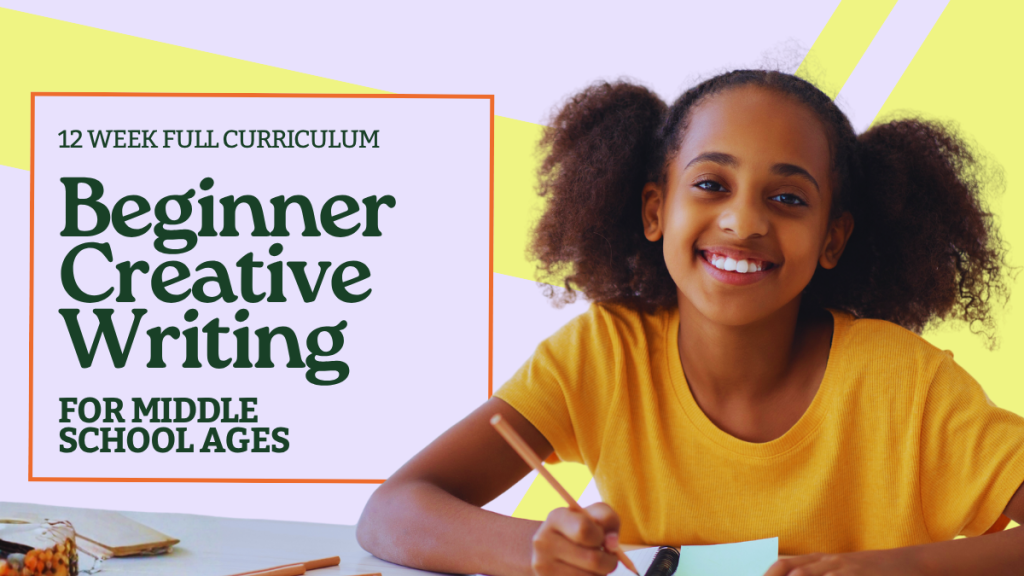
Full semester Beginner Creative Writing for middle school ages.
Beginner Middle School Creative Writing is a foundational, self-paced storytelling course for middle schoolers who want to learn how to write — or who already love stories and want to finally learn how to build one of their own. No prior experience needed. Just imagination and curiosity.
Over 12 weeks, students work through pre-recorded video lessons on the core elements of fiction: character creation, story structure, setting, point of view, dialogue, figurative language, symbolism, pacing, and revision. Each lesson is designed specifically for middle school learners — conversational, supportive, and focused on creativity rather than drills.
Every week includes a video lesson, a creative activity, a writing prompt, and personalized written or audio feedback from a real instructor. The feedback is warm, specific, and designed to help each student grow while keeping the writing process something they actually enjoy.
Assignments are flexible enough to work across any genre your child loves — fantasy, mystery, sci-fi, adventure, horror, realistic fiction, or anything in between. Because the course is self-paced, students can move through the material on their own schedule without losing the structure and support of a real course.
By the end of the 12 weeks, students will have a collection of original writing and a polished final short story — plus stronger skills, greater confidence, and a real understanding of how stories work.
Week 1 — What Is Creative Writing?
Students learn what creative writing is and how it differs from other kinds of writing — and start thinking about writing as a tool for expressing ideas, imagination, and emotion.
Week 2 — Character and Conflict
Every story needs a character and a problem. Students learn how conflict gives characters something to react to and overcome, and write their first story scene.
Week 3 — Story Structure
Students explore basic story arc — beginning, middle, end — and learn how to organize their ideas into something that feels satisfying and complete.
Week 4 — Building Characters
Personality, motivation, and voice. Students create original characters with clear traits and compelling goals — the kind of people a reader actually wants to follow.
Week 5 — Setting and Sensory Detail
How to bring a place to life through sensory details and word choice — making settings feel real, vivid, and meaningful to the story.
Week 6 — Point of View
First person, third person limited, third person omniscient — students experiment with each and discover how the narrator’s perspective changes everything about how a story feels.
Week 7 — Dialogue
How characters speak, think, and respond to one another. Students practice writing conversations that sound natural and reveal who a character is without spelling it out.
Week 8 — Figurative Language
Similes, metaphors, imagery — students learn how to use figurative language to make their writing more vivid, surprising, and memorable.
Week 9 — Symbolism and Personification
How authors use symbols and personification to layer meaning and emotion into a story — then students try it in their own scenes.
Week 10 — Pacing
Fast scenes, slow scenes — students discover how sentence length and structure control the speed and emotional weight of a story.
Week 11 — Revision
What revision really means (it’s not just fixing spelling). Students revisit a past piece and make it genuinely stronger — tightening character, pacing, and voice.
Week 12 — Final Story
Students apply everything they’ve learned to write a complete short story that showcases their creativity, their skills, and how far they’ve come.
CCSS.ELA-Literacy.W.6–8.3 — Narrative Writing
Students write original stories and scenes each week, developing characters, settings, conflict, and plot structure — building toward a complete, polished short story that demonstrates foundational narrative technique.
CCSS.ELA-Literacy.W.6–8.4 — Production and Distribution of Writing
Students produce clear, coherent writing appropriate to task, purpose, and audience — experimenting with dialogue, description, different points of view, and complete short story drafts across the 12 weeks.
CCSS.ELA-Literacy.W.6–8.5 — Strengthening Writing Through Revision
A dedicated revision week, combined with ongoing personalized instructor feedback throughout the course, develops students' ability to revise with intention — strengthening character, pacing, and voice rather than simply editing for errors.
CCSS.ELA-Literacy.W.6–8.10 — Range of Writing
Students write consistently across 12 weeks in a variety of forms and approaches, building stamina and confidence as writers over an extended time frame.
CCSS.ELA-Literacy.L.6–8.3 — Knowledge of Language
Students make deliberate choices about language and style — exploring dialogue versus description, experimenting with point of view, and developing an understanding of how word-level decisions shape a reader's experience.
CCSS.ELA-Literacy.L.6–8.5 — Figurative Language and Nuance
Students explore simile, metaphor, imagery, symbolism, and personification as intentional craft tools — learning to use figurative language to make their writing more vivid and emotionally resonant.
Create a parent account so we can save your child, enrollment, reminders, and checkout details.
You’ll come back to this class after creating your account.
Continue to enrollment when you’re ready.