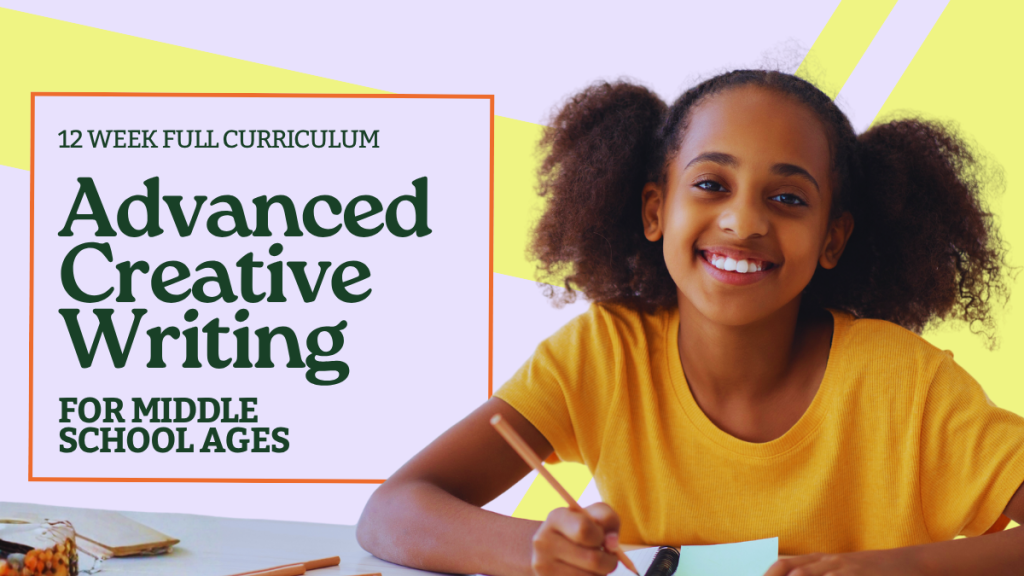
Full semester Advanced Creative Writing class for middle school aged learners.
Advanced Middle School Creative Writing is a self-paced course for middle school writers who are ready to push their storytelling further — into more ambitious structures, deeper emotional territory, and a stronger sense of their own voice. If your student has some writing experience and wants to write with real craft and complexity, this is the course for them.
Over 12 weeks, students work through pre-recorded video lessons on the techniques that give stories depth and staying power: subplots, theme, epistolary storytelling, symbolism, flashbacks, high stakes, emotional pacing, trope subversion, and voice. Each week introduces a concept that pushes them to think about how stories create meaning — not just what happens, but why it matters and how it lands.
Every week includes a video lesson, a creative activity, a writing prompt, and personalized written or audio feedback from a real instructor. The feedback is thoughtful and specific — designed to sharpen each student’s instincts, push their ideas further, and help them develop a voice that’s genuinely their own.
Because the course is self-paced, students can move through the material on their own schedule without losing the structure and support of a real course. Assignments are flexible enough to work across any genre — fantasy, sci-fi, horror, mystery, adventure, realistic fiction, or anything else.
By the end of the 12 weeks, students will have a collection of original work and a polished final story that showcases real growth in structure, emotional depth, and storytelling technique.
Week 1 — Subplots
Students learn how to craft subplots that add depth and complexity to a story — supporting or contrasting the main plotline in ways that make the whole thing richer.
Week 2 — Themes
How meaningful themes like justice, identity, or belonging get woven into genre stories without feeling heavy-handed. Writers explore theme as something that emerges from character and action, not something stated outright.
Week 3 — Epistolary Stories
Creative story structures told through diary entries, letters, text messages, or timestamped scenes — and how nonlinear formats can do things traditional narrative can’t.
Week 4 — Symbolism and Repetition
How repeated images, objects, or phrases build deeper meaning across a story — so even small details carry emotional weight by the time they pay off.
Week 5 — Time Jumps and Flashbacks
How to use flashbacks and time shifts to reveal new information and change the reader’s understanding of everything happening in the present.
Week 6 — High Stakes and Tension
How to raise emotional or situational stakes to keep readers engaged — even when the conflict isn’t life-or-death. Students write scenes where something genuinely matters.
Week 7 — Emotional Pacing
How sentence structure and pacing mirror emotional intensity — and how to write scenes that feel vivid and real by matching the rhythm of the prose to what the character is feeling.
Week 8 — Subverting Tropes
How to identify common storytelling conventions and twist them — creating surprise, originality, and stories that feel fresh rather than familiar.
Week 9 — Writing from Experience
Drawing on real emotions to bring authenticity to characters — even in fantastical or futuristic settings. The truth of how something feels, applied to any story.
Week 10 — Polishing Voice
Students revise a previous piece with focused attention on voice — refining word choice, rhythm, and sentence flow until the writing sounds unmistakably like them.
Week 11 — Full Story Planning
With all their tools in hand, students plan a complete story with a main plot, a subplot, and a clear emotional arc — ready to execute in Week Twelve.
Week 12 — Final Story Draft
Writers bring everything together in a polished short story that showcases their growth in structure, style, character, and storytelling skill.
CCSS.ELA-Literacy.W.6–8.3 — Narrative Writing
Students write original stories and scenes each week using advanced narrative techniques — including subplots, flashbacks, nonlinear structures, symbolism, emotional pacing, and intentional voice — building toward a polished final story with a main plot, subplot, and emotional arc.
CCSS.ELA-Literacy.W.6–8.4 — Production and Distribution of Writing
Students produce clear, coherent writing across a range of forms and formats — including epistolary storytelling (diary entries, letters, timestamped scenes) and traditional narrative — with development, organization, and style matched to purpose and audience.
CCSS.ELA-Literacy.W.6–8.5 — Strengthening Writing Through Revision
Students dedicate Week Ten to revising previous work with a focus on voice, word choice, and sentence rhythm — with ongoing personalized instructor feedback throughout the course supporting growth and refinement at every stage.
CCSS.ELA-Literacy.W.6–8.10 — Range of Writing
Students write consistently across 12 weeks, experimenting with a wide range of structures, techniques, and emotional registers — building creative range, stamina, and confidence over an extended time frame.
CCSS.ELA-Literacy.L.6–8.3 — Knowledge of Language
Students make deliberate choices about language, voice, and style — including dedicated work on polishing voice, sentence rhythm, and how pacing and word-level decisions shape a reader's emotional experience.
CCSS.ELA-Literacy.L.6–8.5 — Figurative Language and Nuance
Students explore symbolism, repeated imagery, and trope subversion as intentional craft tools — learning to use figurative language and narrative convention with nuance, purpose, and originality.
Create a parent account so we can save your child, enrollment, reminders, and checkout details.
You’ll come back to this class after creating your account.
Continue to enrollment when you’re ready.